
A modern approach to tennis forehand grips

First and foremost, your forehand grip is the key - it determines more about your tennis game than almost any other technical choice.
It does many things to your fgame, e.g. shapes the angle of your racket face at contact, the type of spin you can produce, where your ideal contact point sits, and which balls you handle well or struggle with.
If you change your grip by a single bevel - you'll porbably change the entire character of your forehand.
What is the problem then? Well, even the most recreational players have never consciously chosen their grip. They just picked up a racket one day and held it however felt natural. And some got lucky, but many didn't!
Learn it before it is too late - here are the four main forehand grips, and how to decide which one fits better.
Learn about the bevels
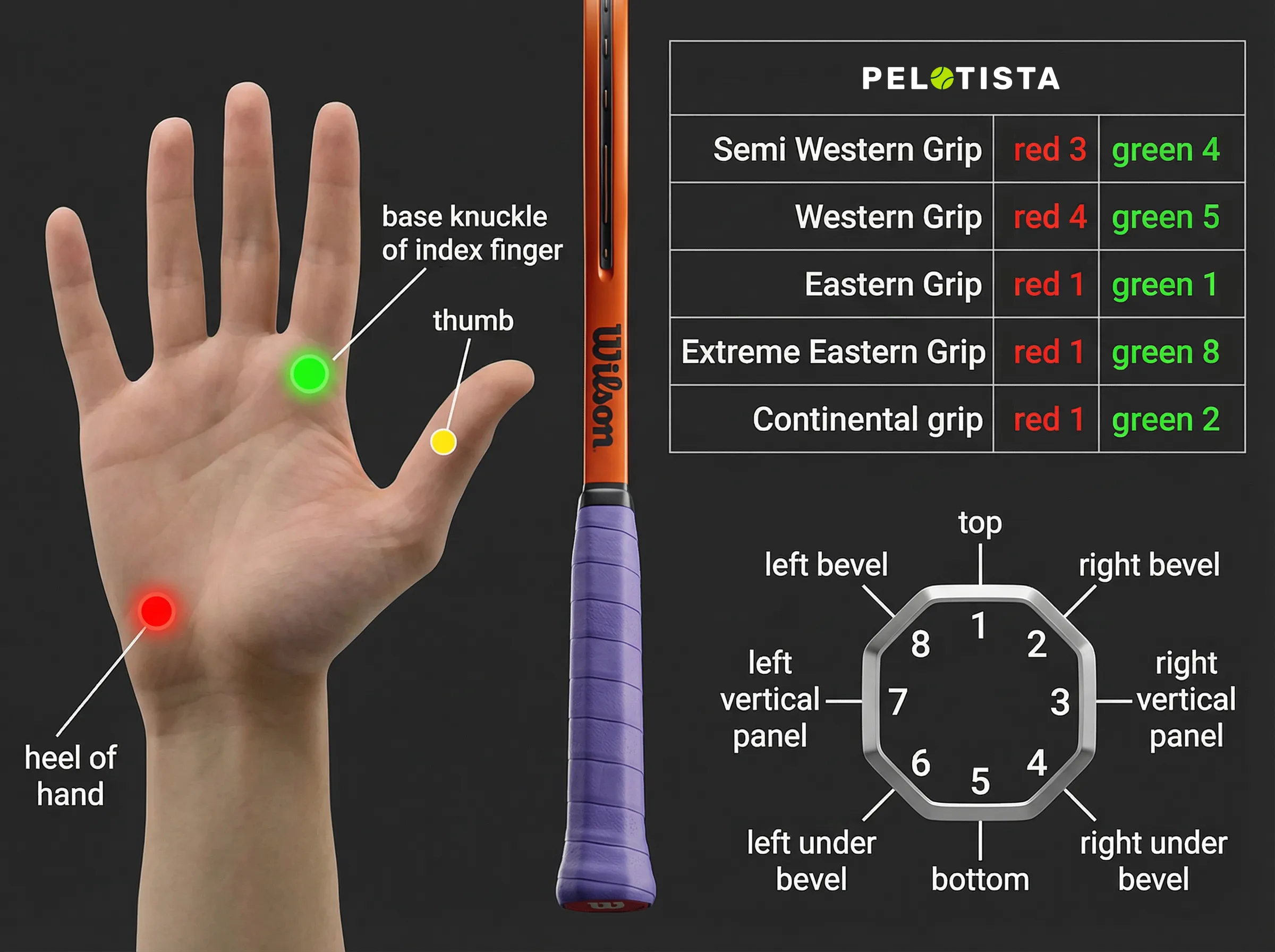
Every tennis racket handle has an octagonal cross-section with eight flat sides called bevels, numbered 1 through 8. When you hold the racket with the strings perpendicular to the ground and the edge facing you:
Bevel 1 is the top flat, directly on top of the handle.
Bevel 2 is the upper-right flat (for right-handers).
Bevel 3 is directly to the right.
Bevel 4 is the lower-right flat.
Bevel 5 is the bottom flat.
The two reference points that matter are your index knuckle (the base knuckle of your index finger) and your heel pad (the fleshy pad at the base of your palm). Where these two sit on the handle defines your grip. For left-handers, everything mirrors to the opposite side.
As you move your hand from bevel 2 down toward bevel 5, the racket face closes more (tilts forward), your contact point moves further in front of your body, and you naturally generate more topspin. That is the core tradeoff behind every grip choice.
1. Continental grip (bevel 2)
The continental grip places your index knuckle on bevel 2. The easiest way to find it: hold the racket like a hammer, or imagine you are chopping down with the edge of the frame. Your hand sits on top of the handle.
This was the standard forehand grip through the 1960s and 1970s, used by legends like Rod Laver, John McEnroe, and Bjorn Borg (who combined it with extreme wrist action to generate topspin that was revolutionary for his era). It produces a naturally open racket face, which makes it easy to hit flat shots and slice but difficult to generate consistent topspin.
Strengths: Excellent for volleys, serves, overheads, and slices. No grip change needed when transitioning from groundstrokes to net play -- which is why serve-and-volley players loved it.
Weaknesses: Very difficult to generate topspin on the forehand. Struggles badly with high-bouncing balls. On modern clay courts with heavy topspin rallies, a continental forehand is a serious liability.
Who uses it today: Nobody uses a continental forehand on the professional tour anymore. But every pro still uses it for serves, volleys, and overheads. It remains the first grip every beginner should learn -- just not for the forehand.
2. Eastern forehand grip (bevel 3)
Move your hand one bevel clockwise and you get the eastern forehand grip: index knuckle on bevel 3. A quick way to find it: lay the racket flat on a table and pick it up as if shaking its hand. Your palm sits flush against the right side of the handle.
The eastern grip was dominant from the 1970s through the early 2000s. It produces a relatively flat ball flight with moderate topspin, and the contact point sits roughly even with your front hip - not too far in front, not too far to the side.
Strengths: Clean, flat ball-striking with good pace. Best grip for handling low balls (skidding shots on hard courts and grass). Easy to flatten out approach shots. Quick grip changes to continental for volleys. Very natural feel for beginners.
Weaknesses: Limited topspin potential compared to semi-western and western. High-bouncing balls (above shoulder height) are uncomfortable. Against heavy topspin players on clay, you are constantly hitting balls in an awkward zone.
Who uses it: Roger Federer is the most famous eastern grip player, though his grip actually sits between bevel 3 and bevel 4 - a "modified eastern" that gives him slightly more topspin than a pure eastern while keeping his flat-hitting ability. Juan Martin del Potro used a classic eastern grip to generate some of the hardest flat forehands in tennis history.
3. Semi-western forehand grip (bevel 4)
Index knuckle on bevel 4. To find it from the eastern, rotate your hand one more bevel underneath the handle. The racket face now tilts slightly closed (forward) at rest, and your contact point shifts further in front of your body.
This is the dominant forehand grip on the modern professional tour, and for good reason. It hits the sweet spot between topspin and power - you can brush up the back of the ball for heavy spin, but you can also flatten it out and drive through the court when the opportunity is there. The "windshield wiper" finish that defines the modern forehand is a natural consequence of this grip.
Strengths: Heavy topspin with good pace. Handles medium-to-high balls very well. Allows both aggressive drives and defensive lobs. The most versatile forehand grip available - works on all surfaces.
Weaknesses: Low, skidding balls require bending your knees significantly to get under the ball - more physically demanding than with an eastern grip. Truly flat hitting is harder (though not impossible). Grip transition to continental for volleys is slightly slower than from eastern.
Who uses it: The majority of the current top 20 on both tours. Novak Djokovic, Carlos Alcaraz, Jannik Sinner, Daniil Medvedev, and Iga Swiatek all use semi-western grips, though with slight individual variations.
Alcaraz, for instance, sometimes drifts between eastern and semi-western, similar to Federer, which gives him extra versatility and disguise on his shots. Sinner's sits firmly on bevel 4, producing a flatter, more penetrating ball than Alcaraz's loopier swing path.
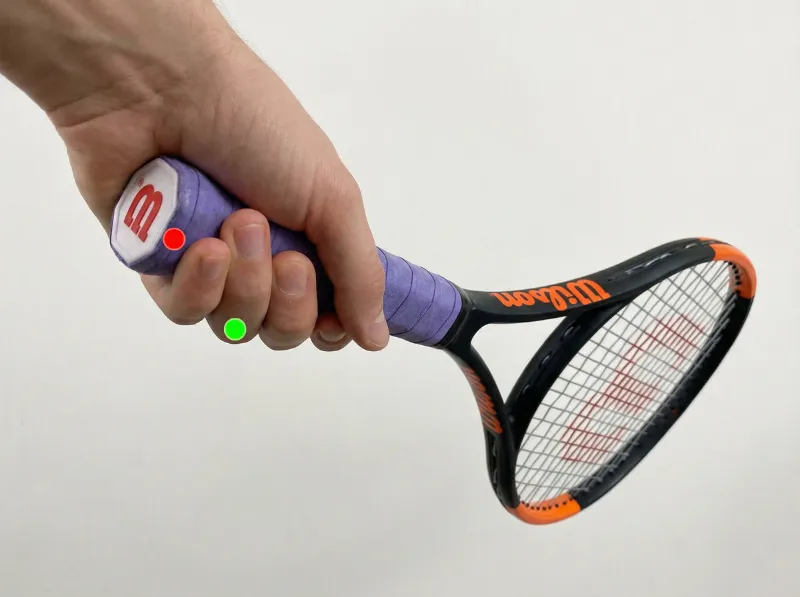
4. Western forehand grip (bevel 5)
Index knuckle on bevel 5, essentially underneath the handle. The racket face is heavily closed, the contact point is well in front of the body, and the natural swing path brushes sharply up the back of the ball.
The western grip produces the heaviest topspin of any standard grip. Balls jump off the court with a high, kicking trajectory that pushes opponents behind the baseline. On clay, where the ball bounces higher and slower, this can be devastating.
Strengths: Extreme topspin. Handles high balls (shoulder height and above) with ease. Creates enormous margin over the net. On clay, the ball kicks up into uncomfortable hitting zones for opponents.
Weaknesses: Low balls are genuinely difficult - you have to drop very low and scoop under the ball. Flat hitting is almost impossible. Transitioning to net play is slow because the grip change to continental is large. Slice forehands and drop shots are awkward. The extreme wrist position can also contribute to wrist and elbow injuries over time.
Who uses it: Jack Sock, Kei Nishikori, Kyle Edmund, and Karen Khachanov on the ATP side. On the WTA tour, the western grip is having a moment: as of late 2025, three of the top five women - Iga Swiatek, Coco Gauff, and Mirra Andreeva -- all use full western grips. Swiatek's extreme grip is a big part of why she dominates on clay but has historically struggled at Wimbledon, where the low bounce exposes the western grip's main weakness.
Rafael Nadal's grip sits between semi-western and full western, varying by surface and shot. On clay, he drifts toward a fuller western position for extra spin - his forehand averaged around 3,200 RPM with peaks near 5,000 RPM, among the highest ever recorded on tour.
There is also the Hawaiian grip (sometimes called extreme western), which goes even further past bevel 5. Alberto Berasategui was famous for this grip in the 1990s - he could hit forehands and backhands with the same side of the racket. It produced massive topspin on clay but was almost unusable on other surfaces. No one on the current tour uses it, and coaches universally advise against it due to the wrist strain it causes.
Quick comparison
Grip | Bevel | Topspin | Flat power | Low balls | High balls | Pro example |
|---|---|---|---|---|---|---|
Continental | 2 | Minimal | Good | Excellent | Poor | McEnroe (historical) |
Eastern | 3 | Moderate | Excellent | Very good | Average | Federer, Del Potro |
Semi-Western | 4 | Heavy | Good | Average | Very good | Djokovic, Alcaraz, Sinner |
Western | 5 | Extreme | Poor | Poor | Excellent | Sock, Nishikori, Nadal* |
*Nadal's grip varied between semi-western and western depending on the shot and surface.
A practical advice
If you are a beginner, start with the eastern forehand grip. It is the most forgiving, the easiest to learn, and it lets you develop clean ball-striking habits without worrying about extreme spin mechanics. You can always move toward semi-western later once your technique is solid.
If you are an intermediate player looking for more topspin, the semi-western grip is the best all-around choice. There is a reason it dominates the professional tour. It gives you topspin for safety and margin, enough flat power to put balls away, and works on every surface.
If you play mostly on clay and face a lot of high-bouncing balls, a strong semi-western or even western grip makes sense. The extra topspin helps you control rallies and the high contact point becomes natural rather than awkward.
If you play fast hard courts or grass, the eastern or mild semi-western grip serves you better. Low, skidding balls are common on these surfaces, and you need the ability to flatten out your shots and drive through the court.
Common mistakes with the grip
Our coaches see the same problems over and over:
Holding the racket too tightly. A death grip kills wrist flexibility, reduces racket head speed, and tires your forearm. Your grip should firm up at contact and relax between shots. Think of holding a bird -- tight enough that it can't fly away, loose enough that you don't hurt it.
Using the same grip for everything. Many beginners hit forehands, backhands, volleys, and serves with the same grip because they never learned to switch. This limits every shot. The continental should be your default for serves and volleys; the forehand grip is for forehands.
Gripping too far up the handle. Choking up reduces leverage and power. Your hand should sit at the bottom of the grip, with the butt cap visible below your pinky.
Not spreading the fingers. Bunching all your fingers together reduces control. A slight gap between your index and middle fingers (the "trigger finger" position) gives you more feel and stability.
Grip and injury risk
Your grip choice affects more than just ball flight - it also determines which joints take the most stress. Research on nonprofessional players found clear patterns:
Western grip users experienced wrist injuries at a 30% rate, compared to 10% for semi-western and 13% for eastern. The extreme ulnar deviation required to generate topspin puts significant strain on the ECU tendon and ulnar side of the wrist.
Eastern grip users showed higher rates of radial-sided wrist issues, but a more neutral elbow angle -- making it the grip most often recommended for players with tennis elbow.
Semi-western sits in the middle for both wrist and elbow stress, which is another reason coaches default to it.
Djokovic's career is a real-world example. His early, more extreme grip forced his elbow to stay tucked tight to his body. When he tried to flatten out shots despite this positioning, the biomechanical stress contributed to the elbow issues that eventually required surgery. His subsequent grip refinement was partly injury-driven.
Should you change your grip?
Changing a forehand grip as an adult recreational player is possible but uncomfortable. Your current grip is wired into muscle memory - every swing you have ever taken reinforces it. Switching to a new grip feels wrong for weeks, and your results will get worse before they get better.
That said, it is worth doing if your current grip is genuinely holding you back. If you are using a continental for your forehand (common among self-taught players), switching to eastern will unlock topspin you literally cannot produce right now. If you are on an eastern and want more topspin, moving to semi-western is a smaller adjustment.
Expect 4-8 weeks of awkwardness for a one-bevel shift. A two-bevel change (e.g., continental to semi-western) can take 3-6 months to feel fully natural. The best approach is to use the new grip in practice drills first, then gradually introduce it in match play once the motion starts to feel automatic.
One thing coaches agree on: do not change your grip during a match. If you are experimenting with a new grip, commit to it in practice. Switching back and forth under pressure will confuse your muscle memory and make both grips worse.
Finale
The semi-western grip is the standard for modern tennis. It offers the best combination of topspin, power, and versatility. If you are building a forehand from scratch or looking to upgrade from a continental or eastern grip, bevel 4 is where the game is heading.
But "best" depends on your playing style, your surface, and your body. Federer built arguably the greatest forehand in history with a modified eastern grip. Nadal dominates on clay with something closer to western. Djokovic, Alcaraz, and Sinner all use semi-western and yet their forehands look and behave very differently.
The grip is the foundation, not the whole house. What you build on top of it - your swing path, your footwork, your timing, your tactical decisions - matters just as much.


