
Padel rules and how to play: the complete guide (2026)
 Mike Podrabinek

Padel is played in doubles, on a court surrounded by glass walls, with an underhand serve and walls you can play the ball off. The scoring is the same as tennis. If you know those five things, you already understand more than most people do before their first game.
This guide does two jobs. It starts with how to play padel, step by step, for your first game. Then it covers the complete ruleset as published by the International Padel Federation (FIP), including the changes that came into effect on 1 January 2026 - the Star Point scoring system, updated serve position rules, safety cord enforcement, and tighter time regulations.
How to play padel: a quick start
Padel is easy to start. You need four players, a court, a racket each and a few balls. You do not need to buy anything for your first game: most venues hire out rackets and balls, according to LTA Padel. Here is how a game works, step by step.
Find three other players and book a court. Padel is played in pairs, two against two.
Wear comfortable sports clothes and trainers with good grip. Most courts are artificial grass with sand on top, so smooth running soles tend to slip.
Warm up for a few minutes, then decide who serves first. Spinning a racket works fine.
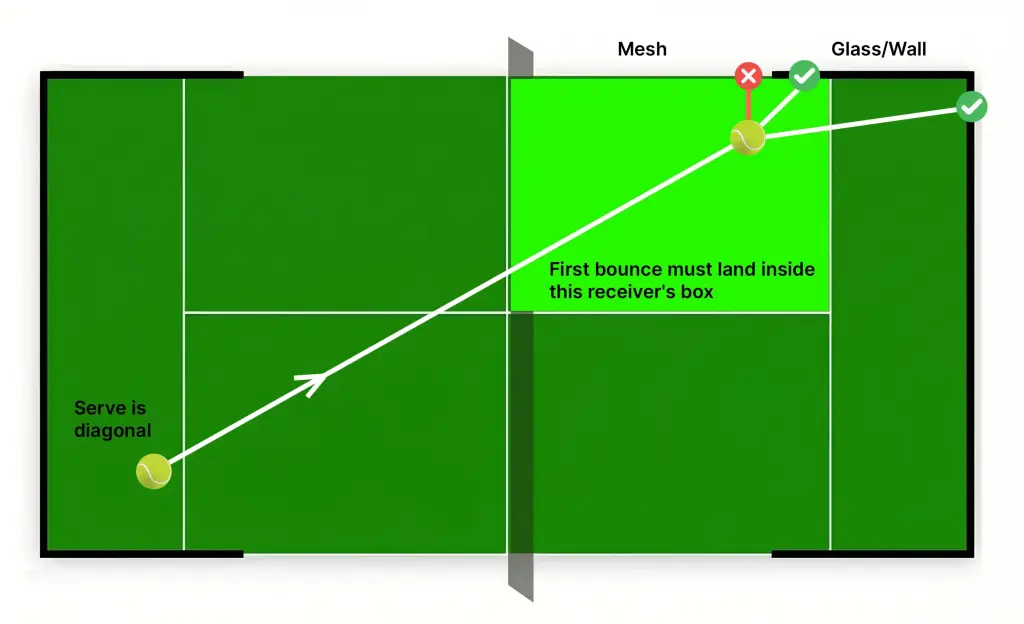
The server stands behind the service line, bounces the ball and hits it underhand, at or below waist height, diagonally into the opposite service box.
The receiver lets the ball bounce, then hits it back. From then on, any player can volley the ball before it bounces.
On your side, the ball may bounce on the floor once. After that bounce it can hit the walls, and you can still play it.
The rally goes on until someone misses: the ball bounces twice, goes into the net, or hits a wall on the other side before bouncing on the floor.
Score like tennis: 15, 30, 40, game. Six games win a set, most matches are best of three sets, and you change ends after every odd game.
The rest of this guide explains each of these rules in detail. First, three things that help more than any rule when you start playing.
Where to stand
Padel is a game of positions. The pair that controls the net usually wins the point, so the basic idea is simple: move forward together, and drop back together.
When your team serves, the server starts behind the service line and the server's partner waits close to the net.
When you receive, the receiver stands near the back of the service box, and their partner usually waits closer to the net.
Try to stay level with your partner. A big gap between you, one at the net and one at the back, is the easiest space for your opponents to hit into.
If the other team lobs over you, drop back together, let the ball come off the back wall and play it from there.
The shots to learn first
You do not need many shots to enjoy padel. These four will carry you through your first months:
Groundstroke. A forehand or backhand after the bounce, often after the ball has come off the back glass. Keep the swing short and controlled.
Volley. Hitting the ball before it bounces, at the net. This is where most points are won.
Lob. A high, soft ball over the opponents at the net. It pushes them back and lets your team take the net.
Bandeja. A controlled overhead from around the service line that keeps your place at the net. It is usually the first overhead coaches teach, and our guide to the bandeja shows how to hit it.
Tips for your first game
Let the ball come off the back wall. It feels wrong at first, but it gives you more time, not less.
Do not hit hard. A fast ball often comes off the glass and straight back to your opponents. Placement wins more points than power.
Aim low and at the middle. Balls at the opponents' feet, or between the two of them, are the hardest to return.
Talk to your partner. A quick "mine" or "yours" avoids clashes and missed balls down the middle.
Play with people at a similar level. Our guide to padel levels explains the numbers you will see in booking apps.
The court
The court is what makes padel padel. It is not an open rectangle like a tennis court. It is a box.
According to the official FIP rulebook, a standard padel court measures 20 metres long by 10 metres wide. The back walls are solid glass, typically 3 to 4 metres high. The side walls are a combination of glass (closer to the back) and metallic mesh (closer to the net). The net sits in the centre at 88cm high in the middle and 92cm at the posts.
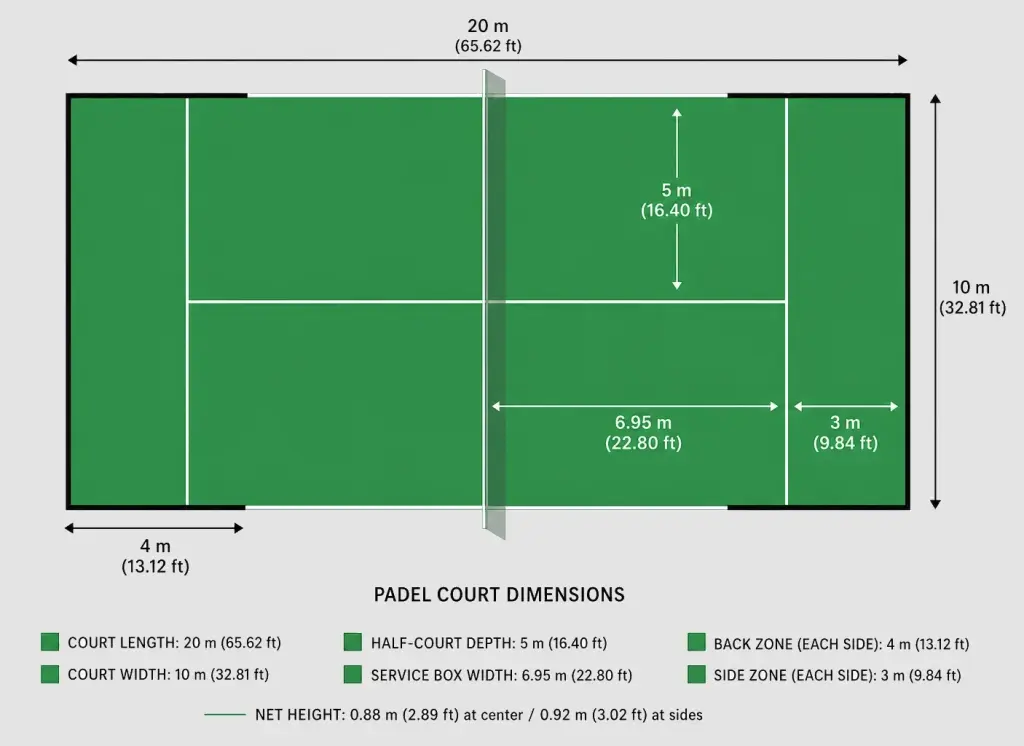
There are doors on each side of the court, usually one per side. These are not just for getting in and out. They are part of the game - players can leave through them to chase down a ball that has gone over the back wall.
The court is divided into two halves by the net, and each half has two service boxes separated by a centre line. If you have played tennis, the layout will look familiar. The difference is everything around it.
The walls are not obstacles. They are part of the playing surface. Once the ball has bounced on the floor, it can hit the back glass, the side wall, or both - and the rally continues. Understanding this is the single most important thing about padel. If you treat the walls as boundaries, you will be confused. If you treat them as extra surfaces to play off, the game makes sense immediately.
Scoring
Standard scoring
Padel uses the same scoring system as tennis. Points go 15, 30, 40, game. To win a set, a team needs six games with at least a two-game lead. If it reaches 6-6, there is a tiebreak. Most matches are best of three sets.
At deuce (40-40), the default is advantage scoring - win the next point to get advantage, then win one more to take the game. If the advantage point is lost, it goes back to deuce. This is the same as tennis and will feel familiar to most players.
The Star Point (new for 2026)
The biggest scoring change in padel for years. The FIP General Assembly unanimously approved the Star Point system on 28 November 2025, effective from 1 January 2026.
Here is how it works:
At deuce, advantage is played normally - just like before. If the team with advantage loses the next point, the score returns to deuce. This is "Deuce 2." Advantage is played again. If the advantaged team loses again, the score goes to "Deuce 3." At Deuce 3, a single deciding point is played - the Star Point. Whoever wins that point wins the game.
There is a small nuance: the receiving team chooses which side of the court to receive the Star Point from. They cannot swap positions to do so - the player on that side receives - but they pick left or right.
The Star Point is mandatory on the FIP Promises circuit (the junior and development tour). For other competitions, tournament organisers can choose between classic advantage, golden point (where the first deuce point decides the game), or the Star Point. At social and club level, most players will not encounter it yet - but it is worth knowing, because it will filter down over time.
You can think of it as a compromise between endless deuces and the abruptness of golden point. You get two fair chances at advantage. If neither team can close it out, one deciding point settles it.
Serving
The serve is where padel differs most visibly from tennis, and where the 2026 rules tightened things up.
How to serve
The serve in padel is underhand. You bounce the ball on the ground and hit it at or below waist height. No overhead serves, no jump serves, no toss-and-smash. This is deliberate - the serve in padel is meant to start the point, not win it outright.
The serve is diagonal, aimed at the opposite service box - same as tennis. You get two attempts. If the first serve is a fault, you try again. Two faults and the point goes to the other team.

What makes a serve a fault. The ball must bounce inside the service box (including the lines) before it does anything else. If it bounces in the box and then hits the back glass, that is fine - the receiver plays it off the wall. But if it bounces in the box and then hits the side mesh (not the glass), it is a fault. If it misses the box entirely, fault. If it hits the net and does not land in the box, fault.
What counts as a let. If the serve clips the net cord but still lands in the correct service box, it is a let - serve again. If it clips the net, bounces in the box, and then touches the wire mesh (not glass), it is also a let.
Server position (updated for 2026)

The 2026 rulebook clarified exactly where the server must stand. At least one foot must be behind the service line. The server must be positioned between the imaginary extension of the centre line and the side wall. Both feet must stay on the ground until the ball has been struck.
The important detail: the ball itself must not cross the service line or the imaginary extension of the centre line before being struck. In practice, this means you cannot let the ball drift forward past the service line on the bounce before you hit it. If it does, it is a fault. This was a grey area before 2026 - now it is explicit.
Receiver position
The receiver can stand anywhere on their side of the court. There are no restrictions. However, the receiver must let the serve bounce before returning it - you cannot volley a serve in padel.
The receiver's partner can stand wherever they like too. Most pairs position themselves with the receiver near the back of the service box and their partner close to the net, but that is tactics, not rules.
Playing the point
The bounce-then-wall rule
This is the rule that defines padel. When the ball comes to your side of the court, it must bounce once on the floor before it can hit a wall. After that first bounce, it can go anywhere - back glass, side wall, two walls in sequence - and the rally continues as long as the ball has not bounced on the floor a second time.
So if your opponent hits a deep lob, the ball bounces on the floor, then rebounds off the back glass - you can still play it. It has only bounced once on the floor. The wall contact does not count as a bounce. This is the heart of padel and the reason rallies last longer than you would expect.
You can also volley during a rally (just not on the serve return). If the ball has not bounced yet, you can take it out of the air at the net. This is standard practice and most winning points in padel come from volleys at the net.
When the ball is out
A ball is out - and the point is over - in any of these situations:
Double bounce. The ball bounces on the floor twice on one side before being played. Point to the other team.
Direct wall hit. Your shot hits the wall or mesh on the opponent's side without bouncing on the floor first. Point to them. The ball must always bounce on the floor on the opponent's side before touching any wall.
Ball leaves the court. The ball goes over the back wall, over the mesh, or out through any opening. Point to the other team - unless it bounced on the opponent's side first, in which case they can exit through the doors and play it.
Ball hits a player. If the ball touches any part of a player's body before bouncing, the point goes to the opposing team. This includes being hit by your own partner's shot.
Playing off the walls
This is the part of padel that looks strange the first time you see it and feels completely natural by the third game.
After the ball bounces on the floor on your side, you can let it hit the back glass or side wall and then play it. You can also hit the ball into your own back wall to send it back over the net - a shot that beginners think is illegal but is actually one of the most common plays in the game.
The most spectacular rule in padel: if the ball bounces on your side and then goes over the back wall (this happens off high lobs), you can leave the court through the side doors and play the ball outside. It must travel back over the net without touching any of your side's walls or mesh from the outside. This does not happen often, but when it does, it is usually the best point of the match.
If you want to see these plays happen for real - and try them yourself - padel programmes across Spain are a good place to learn on proper courts with coaches who can walk you through it.
Dropped racket and safety cord (new for 2026)
The 2026 rules added a clear rule under "Point lost" (Rule 13): if a player's safety cord breaks or they drop their racket during a point, the point is immediately awarded to the opposing pair. No warning, no replay.
This was previously a grey area that led to arguments. Now it is straightforward. Wear your cord. Make sure it is in good condition. Hold on to your racket.
Time rules (updated for 2026)
The 2026 FIP regulations tightened several time-related rules. These mainly affect tournament play, but they are worth knowing because they set the tone for what is considered normal pace.
Warm-up. Reduced from five minutes to three minutes before a match. Restart warm-ups after interruptions are also shorter.
Eating and drinking. Now explicitly prohibited between points. You can eat and drink during changeovers - every odd game when sides switch - but not while walking back to position for the next point.
Time between points. Still 20 seconds, but enforcement is stricter. The clock starts when the previous point ends. At tournament level, expect umpires to enforce this more consistently than in previous seasons.
Heat protocol. A mandatory heat protocol was added for extreme conditions. The details vary by tournament, but the principle is that play can be paused or modified when temperatures exceed safe limits.
Padel Magazine has a full breakdown of the 2026 regulation changes if you want to go deeper.
Equipment rules
The racket

A padel racket has no strings. It is a solid face - usually carbon fibre or fibreglass - with a pattern of holes drilled through it. The holes reduce air resistance and allow some spin, but the feel is completely different from a strung tennis racket.
Maximum dimensions: 45.5cm long, 26cm wide, 38mm thick. Rackets must have a safety cord (wrist strap) attached. Under the 2026 rules, dropping the racket or breaking the cord during a point loses you the point, so this is not just a formality.
The ball
Padel balls look almost identical to tennis balls and behave similarly, with slightly less pressure. The size and bounce specifications have not changed.
As of this year, the ball color is no longer restricted to white or yellow. Any color is permitted as long as it contrasts with the court surface. This is a small change, but you might start seeing colored balls more.
The court surface
Most padel courts in Spain and across Europe use artificial turf with sand infill. Hard courts and other FIP-approved surfaces exist but are less common. The surface affects ball speed and bounce - artificial turf with sand plays a bit slower than hard court, which gives players more time to react and makes wall play more forgiving for beginners.
Editor's note (we play padel, too): if you happen to fall on a sand-filled padel court and glide a bit on your knees or whatever - you will see that it hurts quite a bit. Be careful
Common situations that confuse people
Can you volley in padel?
Yes. After the serve return - which must bounce - you can take the ball out of the air at any point during the rally. In fact, controlling the net and volleying is the dominant tactic in padel. The team at the net usually wins the point.
Can you hit the ball into the opponent's wall?
No. Your shot must bounce on the floor on the opponent's side before it touches any wall. If it hits the back glass or side mesh directly without bouncing, the point goes to the other team. This catches a lot of beginners out - particularly tennis players who try to hit hard and flat.
Can you leave the court while the ball is in play?
Yes. If the ball bounces on your side, clears the back wall, and lands outside the court, you can exit through the side doors and play it back over the net. The ball must not touch your own side's mesh or walls from the outside. It is legal, it is exciting, and it does happen - mostly off very high defensive lobs.
What if the ball hits the mesh on the serve?
It depends on what mesh and when. If the serve bounces in the box and then hits the wire mesh (not the glass panels), it is a let - serve again. If the serve hits the net cord and still lands in the service box, also a let. If it hits the net and misses the box, it is a fault.
What happens if the ball hits you?
You lose the point. If the ball touches any part of your body before bouncing - even if you are standing outside the court - the point goes to the other team. This applies to your partner too. If your partner's shot hits you, the other team wins the point.
Can you play padel with two people?
Yes, but it is not the standard game. Padel is designed for doubles. You can play one against one on a normal court for practice, though it is much more tiring because there is more space to cover. Some clubs have narrower courts built for singles, which suit it better. The rules stay the same: underhand serve, one bounce, and the walls are in play, as LTA Padel explains.
Padel rules vs tennis rules
If you are coming from tennis, this table covers the main differences.
| Padel | Tennis |
|---|---|---|
Players | Doubles only | Singles or doubles |
Court | Enclosed with glass walls | Open |
Serve | Underhand, below waist | Overhand |
Walls | In play after floor bounce | Not applicable |
Scoring | 15-30-40 (same) | 15-30-40 |
Deuce options | Advantage, golden point, or Star Point | Advantage or no-ad |
Leaving the court | Allowed (through doors) | Not applicable |
Racket | Solid face, no strings | Strung |
The bottom line
Padel rules are simpler than they look. The scoring is tennis. The serve is underhand. The walls are in play after a bounce. Those three facts cover most of what you need to walk onto a court and start playing.
The 2026 FIP changes - Star Point scoring, stricter serve position rules, safety cord enforcement, shorter warm-ups, coloured balls - mostly affect competitive and tournament play. If you are playing socially, the core game has not changed. But the rules are moving in a clear direction: faster pace, fewer grey areas, and more decisive outcomes at deuce.
If you are picking up padel for the first time or want structured coaching to go with the rulebook, Pelotista lists padel camps and programs in Spain at every level - from absolute beginners to competitive players. Reading the rules is a good start. Playing a few sets is better.


