
Can you play with a cracked tennis racket?

You pick up your racket after a rough session - maybe you clipped the court on a low forehand, maybe it slipped out of your hand on a serve - and there it is. A thin line running along the frame near the throat or the top of the head. It does not look like much. The racket still feels solid in your hand. You hit a few balls and everything seems fine.
So can you keep playing with it?
The short answer is no, you probably should not. A cracked tennis racket is a compromised racket - structurally, performance-wise, and potentially for your body. Here is why, and everything else you need to know about cracked and broken tennis rackets.
What happens when a tennis racket cracks
A modern tennis racket frame is made of layers of carbon fibre (graphite) woven together and bonded with resin. The frame is hollow, and its strength comes from the integrity of that shell. When a crack forms, even a hairline one, the structure is broken. The frame can no longer distribute force evenly.
That matters more than you might think. Every time you hit a ball, the frame flexes slightly and snaps back. That controlled flex is what gives you power and feel. A crack disrupts the flex pattern - the frame bends unevenly, absorbs shock differently, and transfers energy less efficiently to the ball. You lose power, lose consistency, and the sweet spot effectively shrinks.
Worse, the vibration that would normally be dampened by the intact frame now passes more directly into your hand, wrist, and elbow. Playing with a cracked racket for any extended period increases the risk of tennis elbow and other repetitive strain injuries. The frame is doing less work, so your arm picks up the slack.
And cracks get worse. They do not stabilise. Every hit drives the crack a little further. What starts as a hairline fracture near the throat can work its way up the head, and at some point the frame gives way entirely - sometimes mid-swing, which is exactly as unpleasant as it sounds.
How to tell if your tennis racket is cracked
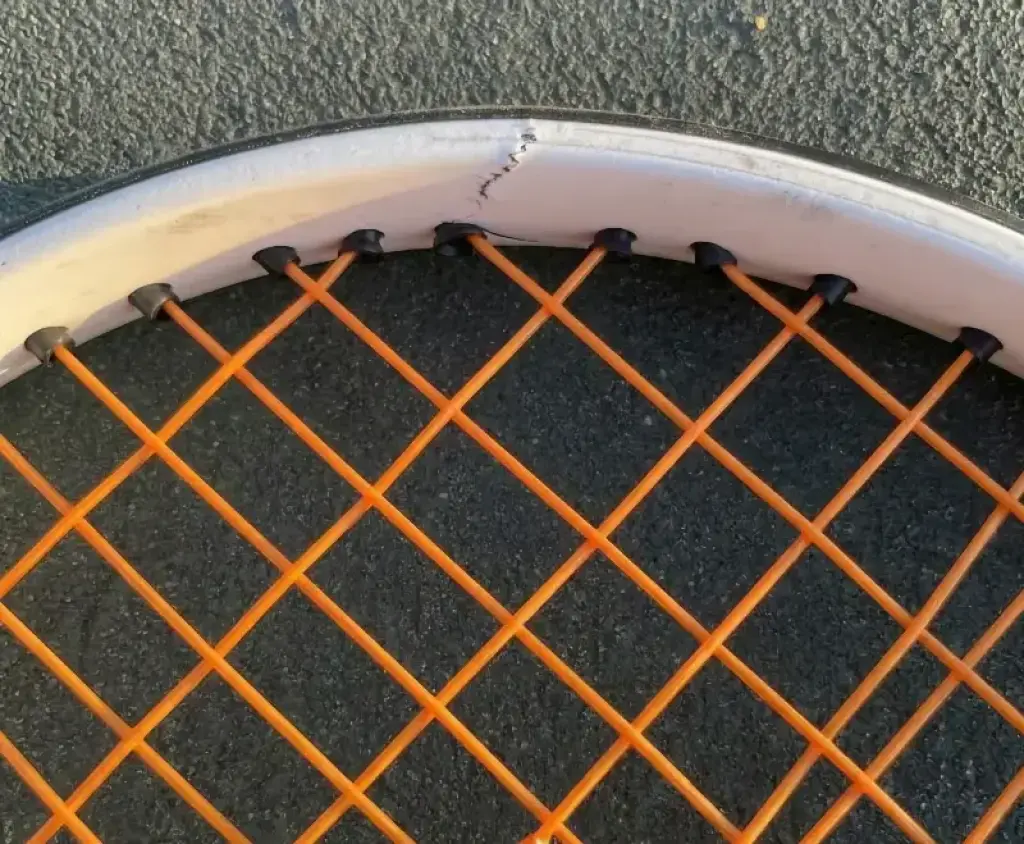
Not all cracks are obvious. A full break is hard to miss, but hairline fractures can hide under paint, under the bumper guard, or inside the grommet strip. Here are some ways to check.
The sound test. Hold the racket by the handle and tap the frame lightly with your knuckle or a coin, working your way around the head. A healthy frame produces a consistent, clear ping. A cracked frame will give you a dull thud or a buzzing rattle at the damaged spot. This is the quickest and most reliable test. Some players tap the frame on the court surface and listen for dead spots.
Visual inspection. Run your fingers slowly along the entire frame, feeling for any irregularity - a ridge, a soft spot, a slight depression. Check carefully around the throat (where the frame splits into two arms) and the top of the head (10 and 2 o'clock positions). These are the most common fracture points. Remove the bumper guard if possible - cracks love to hide under there.
The flex test. Press the head of the racket gently against the ground and apply moderate pressure to the throat. If one side of the frame flexes noticeably more than the other, or if you feel any give that was not there before, something is wrong. Do not overdo this - you are checking, not trying to break it.
On-court clues. A sudden loss of power or control that cannot be explained by your strings is worth investigating. If shots that used to land deep are falling short, or if you are suddenly getting more vibration on contact, your frame might be compromised. A dead, hollow feeling on impact is a classic sign.
If you are having your racket restrung, ask your stringer to check the frame. Good stringers do this automatically - they see a lot of rackets and know what cracks look like. They will also notice if the frame distorts under string tension, which is another sign of structural damage.
What causes tennis rackets to crack
Most cracks are not dramatic. They happen gradually, then suddenly. A few common causes:
Ground contact. Scraping the frame on the court surface during low shots is the number one cause. Hard courts are especially punishing - they grind through the paint, then the outer layer of carbon fibre, and eventually compromise the structure. If you play with a lot of topspin and brush up on low balls, your racket takes more abuse than average.
Mis-hits. Hitting the ball on the frame rather than the strings sends a spike of force through a small area instead of distributing it across the string bed. The occasional frame shot is harmless, but repeated mis-hits on the same spot - particularly the top of the head or the sides near the throat - weaken the frame over time.
Temperature extremes. Leaving a racket in a car boot in summer or a cold garage in winter stresses the resin that bonds the carbon fibres. The frame becomes more brittle and more susceptible to cracking on impact. This is a slow killer - you will not notice it happening until the frame fails earlier than it should.
Over-tightened strings. Stringing a racket above its recommended tension range puts the frame under constant stress. Some players chase more control by cranking up the tension, but it shortens the life of the frame. String at the manufacturer's recommended range - or below it - and your racket will last longer.
Impact and rage. Let us be honest - slamming a racket into the court after a bad point is a fast track to a cracked frame. Even a single hard slam can fracture a frame that was perfectly fine a second earlier. It is the most avoidable cause on this list.
Can you fix a cracked tennis racket?
Technically, yes. Practically, it is almost never worth it.
You will find people online who have repaired cracks with epoxy, carbon fibre patches, or fibreglass wraps. Some of these repairs hold up for a while, especially on hairline cracks that have not gone all the way through the frame. The process typically involves sanding the area, applying an epoxy or carbon fibre patch, and clamping it until it cures.
The problem is that you are patching a structural failure in a tool that undergoes repeated high-impact stress. A repaired frame will never flex the way it was designed to. The patch adds weight unevenly, throwing off the balance. The frame is stiffer at the repair point, which means the stress just transfers to the areas on either side of the patch - creating new weak points.
There are also safety considerations. A patched racket that fails mid-match can send a chunk of carbon fibre across the court. That is a low-probability event, but a high-consequence one, especially in doubles.
The one scenario where repair might make sense: a sentimental racket that you want to hang on the wall or use for casual hitting against a wall. For anything competitive, or even regular practice, a cracked racket is a retired racket.
One exception worth mentioning - if your racket is relatively new and cracks under normal use (no ground contact, no abuse), contact the manufacturer. Most brands have warranty policies that cover structural defects. Head, Wilson, Babolat, and Yonex all have warranty programmes, though coverage varies by region and model. Keep your receipt.
How long do tennis rackets last?
This depends heavily on how often you play, how you play, and how you treat your equipment. But here are some general guidelines.
A recreational player who hits once or twice a week can expect a racket to last anywhere from 3 to 10 years. That is a wide range because usage matters so much. A careful weekend player who keeps their racket in a bag, avoids ground contact, and strings at reasonable tension will get the upper end of that range. Someone who plays hard on rough courts and is not particularly careful might see cracks in 2-3 years.
Frequent players - those hitting 3-5 times a week - should expect 1 to 3 years per racket. Competitive club players and collegiate players often rotate through two or three rackets and replace them on a roughly annual cycle.
Professional players go through rackets much faster. The constant restringing, intense hitting, and sheer volume of play means frames lose their responsiveness within weeks or months. Most tour players get fresh frames from their sponsors regularly - some go through 30-50 rackets per year.
What actually wears out? The frame itself gradually loses stiffness as the carbon fibre structure fatigues from repeated impacts. You might not notice the decline because it happens so slowly - it is like a frog in warm water. Then you pick up a new racket of the same model and suddenly realise how dead your old one felt. Experienced players often describe this as the racket losing its "pop" or feeling "mushy."
Player type | Play frequency | Expected lifespan | Notes |
|---|---|---|---|
Casual | 1-2x/week | 3-10 years | Depends on care and storage |
Club player | 3-5x/week | 1-3 years | Rotate 2-3 rackets to extend life |
Competitive/collegiate | 5-6x/week | 6-12 months | Annual replacement cycle common |
Professional | Daily | Weeks to months | 30-50+ frames per year from sponsors |
When to replace your tennis racket
A visible crack is the most obvious signal, but rackets can decline well before that point. Here are the signs that your racket is past its best.
Loss of power. If your shots are consistently landing shorter than they used to, and it is not your strings or your form, the frame may have fatigued. This is especially noticeable after you have had fresh strings put in and the racket still feels flat.
More vibration. A frame that has lost stiffness transmits more shock to your arm. If you are suddenly feeling more impact on off-centre hits, or if you are developing arm soreness that was not there before, your frame might be the problem.
Visible damage. Deep scratches that expose the carbon fibre underneath the paint, chips in the frame, or any crack - however small - means the frame is compromised. Paint scratches alone are cosmetic, but once you can see the dark carbon layer underneath, the frame is losing material.
The sound changes. An old racket sounds different from a new one. The ping becomes duller, the resonance drops. This is subjective, but if you have been playing with the same frame for a few years and it just does not sound right anymore, trust your ears.
Warping. Place your racket on a flat surface and check if it sits evenly. A warped frame - even slightly - affects your string bed and your shots. This can happen after repeated restringing, heavy use, or heat exposure.
How to make your racket last longer
Some of this is obvious, but it is worth spelling out because most racket damage is preventable.
Use a bumper guard. The plastic strip around the top of the frame exists to absorb ground contact. Replace it when it wears down - they cost a few euros and add real protection. Once the bumper is gone, every scrape goes directly into the carbon fibre.
Store it properly. Keep your racket in a bag, out of direct sunlight, and away from extreme temperatures. Do not leave it in your car. A thermal bag is ideal if you play in hot climates - some bags have insulated compartments specifically for rackets.
String within the recommended range. Check the tension range printed on the inside of your frame and stay within it. If you want more control, try a thinner gauge or a stiffer string rather than cranking up the tension. Your frame will thank you.
Rotate rackets. If you play frequently, having two or three identical rackets and rotating them extends the life of each one. It also means you have a backup if one breaks, and the transition is seamless because you are already used to all of them.
Be mindful on low shots. On hard courts especially, try to keep the frame from scraping the surface. A slight adjustment to your low volley or sliding wide ball technique can save your frame from years of accumulated court contact.
Do not slam it. Obvious, but worth repeating. One bad moment of frustration can end a racket that had years of life left in it. Take a deep breath instead. Your wallet will appreciate it, and so will your racket.
The bottom line
A cracked tennis racket is not something to play through. It will hurt your game, it could hurt your arm, and it will eventually fail completely - usually at the worst possible moment. If you find a crack, do the sound test and the flex test to confirm, and then start thinking about a replacement.
The good news is that modern rackets, even at mid-range price points, are well-made and durable. Take reasonable care of your frame - proper storage, sensible string tension, a fresh bumper guard now and then - and it will serve you well for years.
And if your racket does crack? Think of it as an excuse to try that new model you have been eyeing. Every cloud.


